

The future of news is already here. Are you ready?

Trust in news has hit a record low. Interest in news is falling, with more people avoiding it altogether. And for the first time, social media and video networks have overtaken TV and news websites as the main way people access news.
These are some of the key findings from the latest Reuters Institute for the Study of Journalism’s Digital News Report – the ‘bible’ for news about the news.
So far, 2026 has been marked by uncertainty: political instability, economic pressures, changing media habits, and growing questions about where people can get information they trust. That uncertainty is reflected throughout the report.
People around the world describe feeling anxious, cynical, and, frankly, exhausted by the news. However, the report also points to something more complicated: people are not abandoning the news entirely. They are just finding it elsewhere – through social platforms, video, creators, and, increasingly, AI chatbots.
Missed the report? Don’t worry, Clear Europe has you covered. Here are our key takeaways:
Social media and video networks are the most widely used ways of accessing online news
For the first time, social media and video networks – like YouTube and TikTok – have overtaken TV, radio, newspapers, and news websites for media consumption.
According to the report, 54% of audiences globally use social media and video to access news online, compared with 52% for TV and 51% for news websites.
Social media is by far the most popular gateway to online news for under-35s, but also the most widely used means for over-35s. 42% of young people use Instagram to access the news, and 36% use TikTok.
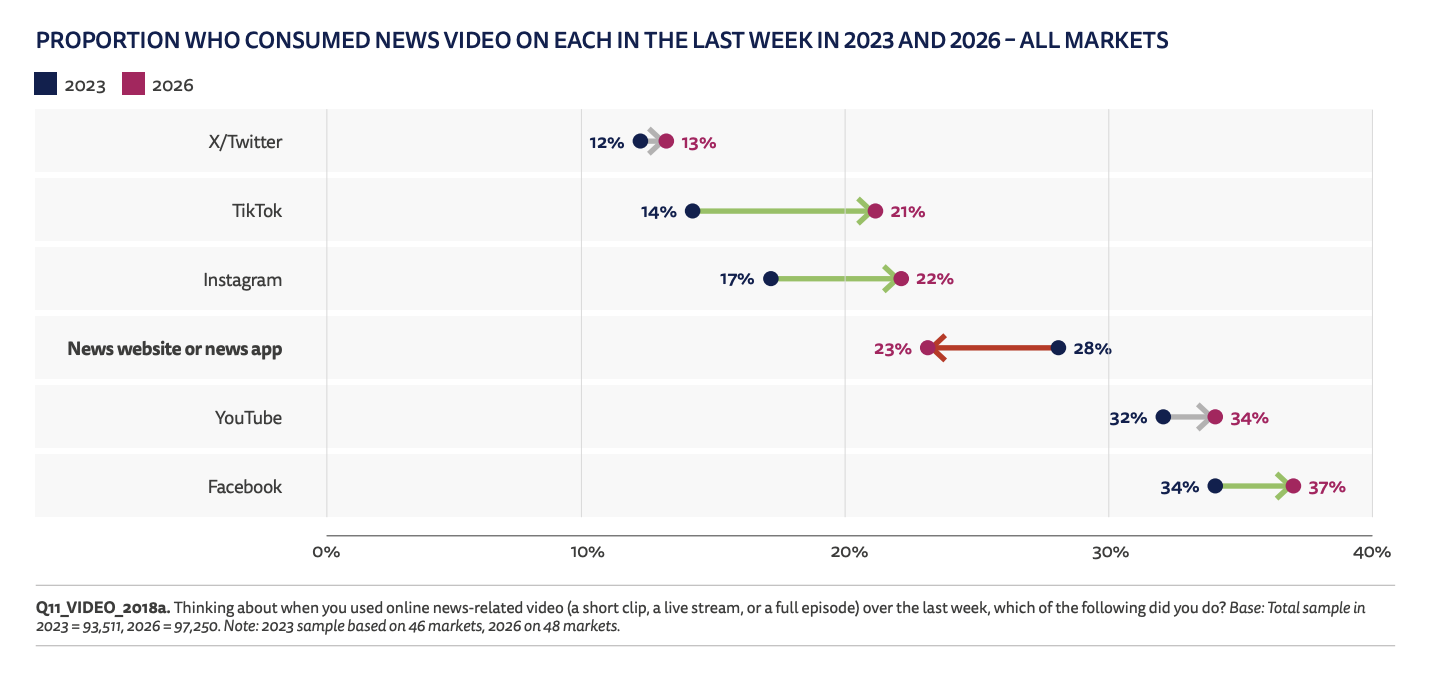
However, this does not mean traditional news organisations are disappearing from the picture. When people consume news on social media and video networks, they are often still seeing content from established news providers, highlighting the importance for news organisations to expand their digital presence.
Trust and interest in news are at historic lows
The drift away from TV, radio and news websites is not only due to changing technology, but also because people are simply less interested in news altogether.
Since 2021, the proportion of people saying they are ‘extremely’ or ‘very’ interested in the news has fallen by 13 percentage points. This is concerning because a less engaged audience is harder to reach, harder to inform and harder to involve in the political process.
Trust is also moving in the wrong direction. In 2026, global trust in news dropped to 37% – the lowest figure since the Reuters Institute began measuring it in 2015.
Many people are simply avoiding the news altogether. 42% of people surveyed said they often or sometimes avoided the news. This is up from 29% in 2017.
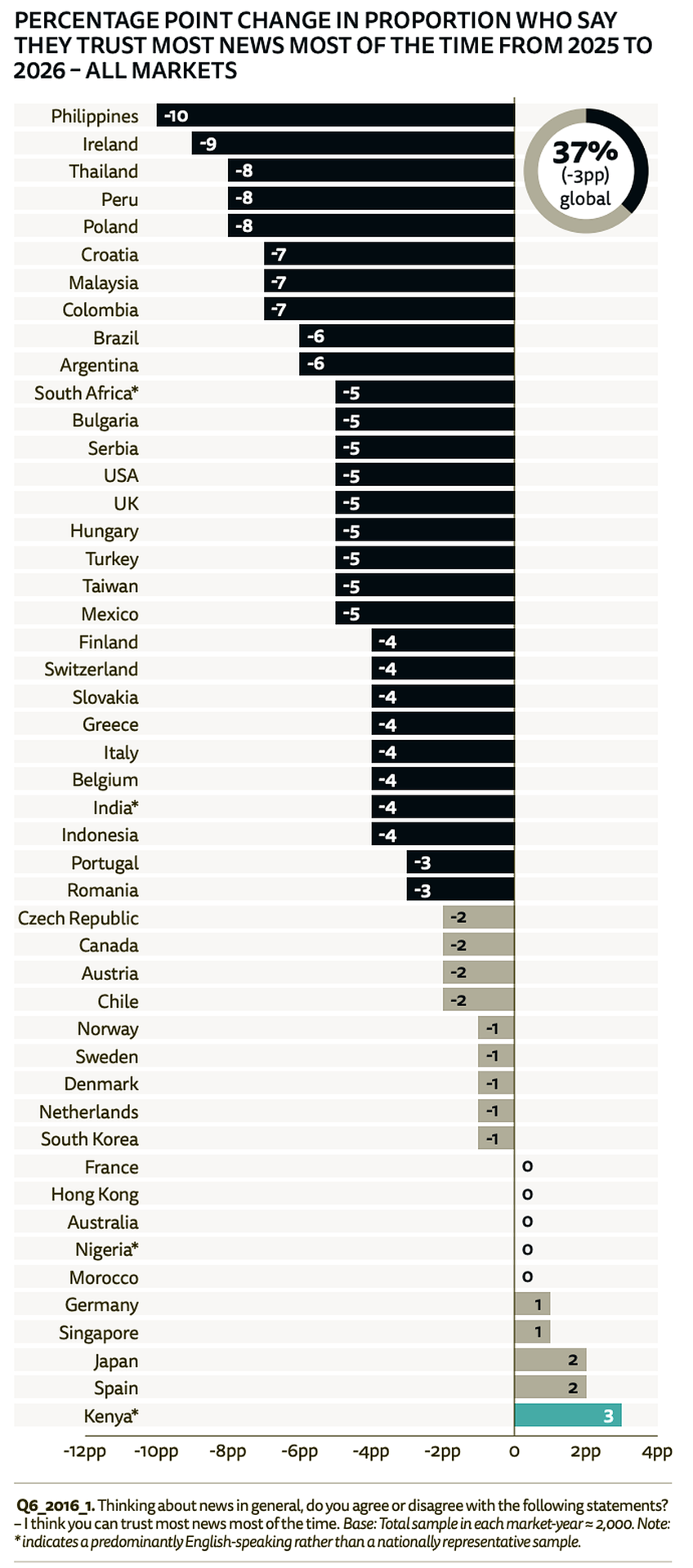
For news organisations, these developments reveal a deeper challenge behind the platform shifts. People are not only changing where they get their news. They are also questioning whether they want it – and whether they even believe it.
The rise of AI news chatbots
Another trend worth noting is the growing use of AI chatbots to get news. The institute describes this phenomenon as a “fast increase” rather than a “sharp one,” but the reasons people are using these tools are just as important as the growth itself.
The report shows that AI chatbot users are drawn to the ability to ask follow-up questions, get faster answers, summarise complicated stories and pull together information from different outlets.
This is where the finding becomes especially important for news organisations. People are not just looking for more news. They are looking for news that is easier to understand, quicker to access and more useful in the moment.
The report says that news organisations can respond to some of these needs directly. There is a clear demand for simpler, more digestible writing. Clearer articles, summarised formats, explainers, and newsletters can all help anticipate what time-poor audiences are looking for.
The Reuters Institute also warns that trying to replicate generic AI tools may not be the way to go. Instead, news organisations may be better served by focusing on what makes their own journalism harder to replace: trusted sourcing, original reporting, clear explanations and work that adds value beyond what AI can quickly summarise.
The big picture
The 2026 Digital News Report shows that news organisations must work harder to gain the public’s trust and rekindle their viewers’ interest in news. This means addressing many concerns that the news is dominated by negativity, bias and constant crisis coverage.
At the same time, publishers need to meet people where they actually are. Increasingly, that means social media and video networks. News organisations must work to make journalism clearer, more useful and more trustworthy in the places where people now get their news.
Author: Cameron Mollan
Cameron Mollaan is a Communications Trainee at Clear Europe, supporting trainings, masterclasses and communications content. He has a background in broadcast and digital journalism, public affairs and international relations, and is currently pursuing a master’s degree in Public Diplomacy and Global Communications at Syracuse University’s Newhouse School and Maxwell School.
Add your comment