
Fake news is a scourge spread with lightning speed thanks to social media. In this guest article, Ethical Journalism Network Director Aidan White explains how journalists – and others who use social media platforms to share information – can avoid spreading lies, misinformation and dubious claims.
Since the American election two of the world’s biggest internet companies have decided to crack down on fake news. Google says it will ban from its online advertising service websites that peddle it and Facebook says it has added fake news to its policy regarding advertising on sites that show misleading or illegal content. Taken together, these decisions are a clear signal that internet publishers are waking up to the dangers of misinformation online.
Journalists know that there’s nothing new about the problem of fake news. Deceptive, unverified, and error-filled reporting has always been with us, but the scourge has grown in the wake of technology that has helped shape a new world of clickbait, viral communications and confirmation bias.
Journalists should follow some simple ground rules to make sure they don’t become victims of slippery stories published online. Here are some starter tips:
- Use fact-checking web sites. Most reputable media already double-check everything that arrives in their inboxes but now freelance journalists and small-scale media can get help from a rapidly-expanding community of online fact-checkers. Sites such as factcheck.org in the United States or the UK’s fullfact.org, for instance.
- Watch out for websites with odd names. Strange domain names or sites that end in “.com.co” for instance are often fake versions of real news sources.
- Check the “About Us” box on the website. Worry if there isn’t one and check the provider with Wikipedia.
Beware of stories not being reported elsewhere. A shocking, outrageous or surprising event will have another source. If it doesn’t, be suspicious. - Be wary if there is no attribution for an author or source. That’s sometimes justified, but should be explained and, if not, don’t trust it.
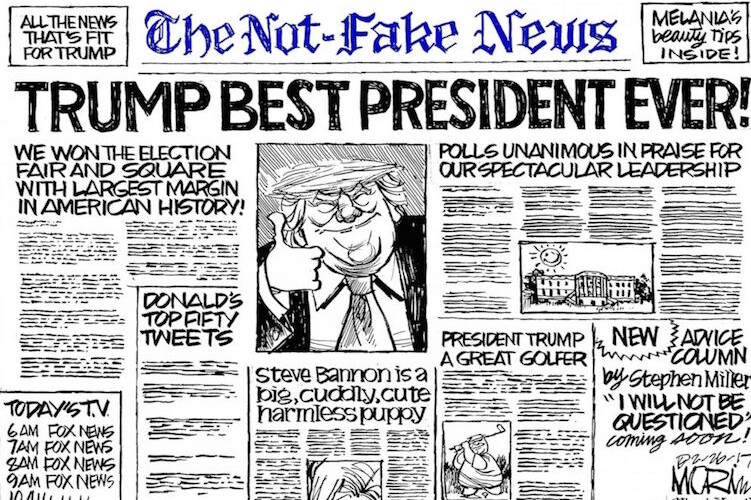
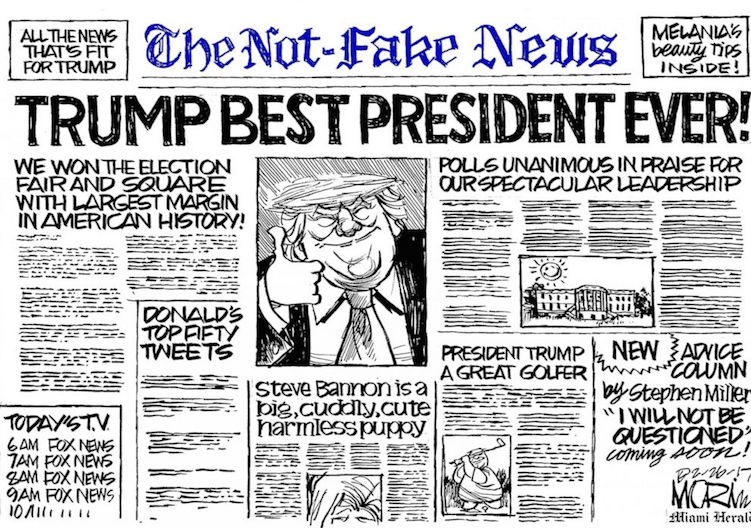
Check the date. One favourite trick of news fakers is to repackage old stories. They may have been accurate but used out of time and out of context they may become malicious falsehoods. - Finally, remember that there’s such a thing as satire. Not all fakery is malicious. It can even be entertaining and may come from reputable sources of journalism. Private Eye, Britain’s leading satirical news magazine, for instance, has done some great fact-based investigative journalism alongside occasionally amusing spoof editorial content, but found itself on a list of “fake-news” sites circulated when the misinformation panic set in after the Trump election.
A full version of this article can be found in Ethics in the News – a recent report from the Ethical Journalism Network on challenges for journalists in the post-truth era.
Cartoon: credits to Jack Ohman for Sunshine Week, The Associated Press.
Related Posts

10 Tips for clear communication
Check out our infographic on the ten commandments for clear communication.

5 tips for getting more newsletter subscribers
Here are our five tips for getting more eyeballs on your newsletter content.

12 tips on how to work with TV journalists
Television journalists need experts that are available at short notice, know what they are talking about and can express themselves clearly and concisely.
Join us
Stay up to date with our latest news