
GARETH HARDING
SEPTEMBER 11, 2015
EXPLAINING THE EU: UNITED IN COMPLEXITY
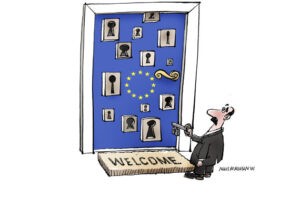
EUobserver article by Clear Europe CEO Gareth Harding explaining how needlessly complicated the EU is.
With over 20 years’ experience describing how the European Union works, what it does and what challenges it faces in speeches, articles, lectures and trainings, I thought I could explain what the EU is all about in terms that anybody could understand. How wrong I was.
In the last month I have given half a dozen ‘EU in an hour’ talks to visiting groups of American politics, journalism and international relations students – who are all extremely keen, bright and willing to ask questions. But almost invariably, the students leave the classroom flabbergasted at how needlessly complicated the EU is and suspecting that I have made up some of the Byzantine decision-making procedures just to mess with them.
This is how the average talk goes:
Me: So basically, you have three main institutions: The European Commission, Parliament and Council.
Q: I thought there were four?
A: Well, yes, if you include the European Council.
Q: Wasn’t that one of the three you just mentioned?
A: No, that’s the Council of the European Union. Which is different from the Council of Europe, which is a non-EU body that meets in Strasbourg.
Q: Doesn’t the European Parliament meet in Strasbourg?
A: It does. But so does the Council of Europe. And to be precise, the Parliament also meets in Brussels.
Q: So, just to be clear, the Parliament has offices in both Brussels and Strasbourg?
A: Yes, and Luxembourg, where a lot of the support staff are based. But anyway, let’s go back to the institutions I mentioned before. Firstly, the European Commission. This is often called the EU executive body.
Q: So, like the U.S. President?
A: Not really. The Commission can’t declare war or veto laws. But it can do trade deals. So, it has some executive functions, but also some legislative.
Q: But my textbook says the parliament and EU Council are the two law-making bodies?
A: Correct, but the Commission proposes all draft laws.
Q: Wait. What? How can an unelected body propose laws? Shouldn’t that be the Parliament?
A: No, the Commission has what they call the ‘sole right of initiative’ because it is supposed to represent the European interest and be free from national prejudices.
“The EU has not been made according to a grand design like a Gothic cathedral.”
Q: But don’t EU member states propose Commissioners?
A: Yes, they do. But when they arrive in Brussels, they have their national hard drives erased. In theory. Unlike the Council of the EU, which represents the naked national interests of the 28 states.
Q: So the Council is a bit like our Senate? One member per state, regardless of size?
A: Yes, except big states like Germany have many more votes than small states like Malta.
Q: So it’s not really like our Senate?
A: Er…no. Anyway, the Council makes laws, along with the Parliament. It also adopts the EU budget, which is about €140 billion a year.
Q: That’s not much. I thought the EU was the world’s biggest economy?
A: Ah, yes, the total GDP of the 28 member states is the biggest in the world, but Brussels is only responsible for about 1% of that.
Q: The Council meets in Brussels, right?
A: Yes, except in April, June and October, when it meets in Luxembourg.
Q: You’re kidding?
A: I wish I was.
Q: So who’s in charge of the EU?
A: Ah, the Kissinger question. In one word – nobody. In reality, there are three presidents – of the European Council, Commission and Parliament. The first two are basically chosen by EU leaders and the third by MEPs. None are directly elected to the post by voters. Oh, and there’s also a presidency of the Council of Ministers.
Q: Wait, what?
A: Well, every six months a different EU state is in charge of chairing ministerial meetings. At present, that is Latvia, but on July 1 that changes to Luxembourg. However, meetings of foreign ministers are presided over by EU foreign policy chief Federica Mogherini, who is also vice-president of the European Commission. And Eurogroup meetings are chaired by Dutch Finance Minister Jeroen Dijsselbloem..
Q: Hang on, what’s the Eurogroup?
A: Well, that’s the meeting of EU finance ministers from the 19 EU states that use the euro?
Q: What? I thought the EU had a single currency?
A: It does, but not for all its states. Britain, Denmark and Sweden decided to keep their own currencies and some central European countries are not ready to join the Eurozone yet.
Q: You’re making this up, aren’t you? The EU can’t possibly be that complicated.
A Belgian townhouse
Unfortunately, it is. Part of the reason is that the EU has not been made according to a grand design like a Gothic cathedral. Instead, its structure more resembles the back-end of a Belgian townhouse: always messy, often ugly and sometimes decidedly dodgy.
It also doesn’t help that the EU is a moving target, constantly changing its name, membership, treaties and even fundamental aims. No wonder over three-quarters of EU citizens don’t know how the Union works.
So what can the EU do to make it simpler to understand?
Firstly, it could be a tad more inventive in labelling its main institutions. Renaming either the European Council or the Council of the EU would be a start. The difference between presidents and presidencies could also be spelled out better.
Secondly, that whole double-hatted Commission VP/Council High Representative thing? That has to go.
Thirdly, stop the travelling circus to Strasbourg. Obviously.
Finally, naming things based on reality rather than wishful thinking would help. The EU doesn’t have a common foreign and defence policy and certainly doesn’t have a single currency, so why pretend it does?
Of course, none of this would make the European Union more popular or prosperous. But it would make it easier to understand – which is surely one policy both supporters and opponents of the EU project should be able to rally around.
This article was originally published in EUobserver on June 18.
Related Posts

22 ugly EU jargon words to avoid
If EU institutions are to stand any chance of reconnecting with disillusioned voters, they must surgically remove jargon and communicate in clear, concrete language.
The myth of the shrinking EU Press corps
Remember all those scary stories about dwindling press numbers in Brussels a few years ago? Well, turns out they were wrong.
10 things you need to know about the EU Press Corps
I have picked out 10 essential facts you need to know about the journalists who report on the EU.
Join us
Stay up to date with our latest news