
Gareth Harding
October 13, 2014
22 Ugly EU Jargon Words to Avoid
Jargon is a form of linguistic cancer eating away at the European body politic. If EU institutions are to stand any chance of reconnecting with disillusioned voters, they must surgically remove jargon and communicate in clear, concrete language.
Unfortunately, this is easier said than done. Over the years, EU officials – and the tens of thousands of lobbyists, diplomats and even journalists who inhabit the Brussels bubble – have developed a bizarre, contorted language of their own. Dubbed ‘Eurospeak’ or ‘Euro-English,’ this lazy, alienating form of talking and writing relies on glueing together vague, abstract and often meaningless phrases like shards of a smashed vase, using long, complicated, show-off words where short, clear, simple ones will do and falling back on unintelligible jargon to express often simple ideas.

EU jargon comes in many guises. There are words and phrases unique to Brussels – like ‘comitology’ and the ‘codecision’ procedure – that are complicated to explain but can be easily translated into clear English with a bit of effort. That will be the topic of our next post. But there is another perversion of language that is even more poisonous – the often meaningless and almost always ugly jargon of modern business and bureaucracy.
Tired, technocratic words like ‘stakeholder,’ ‘framework’ and ‘roadmap,’ cliches like ‘win-win’ and ‘level-playing field,’ euphemisms like ‘social exclusion,’ throw-away terms like ‘holistic’ and ‘inclusive’ and a host of other vague, pompous or foggy phrases cloud clear thinking, mangle the English language and act as a major obstacle to communicating with the outside world. They are not,of course, exclusive to the EU but it is almost impossible to read a European Commissioner’s speech, trade association policy paper or NGO press release without at least one of these dreadful words popping up.
Here are 22 commonly used EU jargon words, with examples, why they are problematic, and clearer alternatives:
- Actions. Example: “The first Horizon 2020 call includes several opportunities to support multinational demand-driven innovation actions…” Why not: Vague, often redundant. Alternatives: Activities, measures, initiatives.
- Actors. Example: “All non-profit non-state actors…” Why not: Actors belong on stage. Alternatives: NGOs, business groups, participants.
- Capacity-building. Example: “The project focuses on capacity-building…” Why not: Vague and bureaucratic. Alternatives: Be specific — what capacity?
- Citizens. Example: “European citizens’ rights…” Why not: Turns people into political objects. Alternatives: People, Europeans.
- Civil society. Example: “Pressure on civil society groups…” Why not: Meaningless without specifying who. Alternatives: NGOs, unions, community groups.
- Cross-cutting. Example: “Cross-cutting policy analysis…” Why not: Ugly and redundant. Alternatives: Widespread, across the board.
- Deliverables. Example: “Reports and deliverables…” Why not: Bureaucratic and vague. Alternatives: Outcomes, results.
- Driver. Example: “Trade is an important driver…” Why not: Overused business jargon. Alternatives: Trade drives growth; catalyst.
- Framework. Example: “In the current framework…” Why not: Vague and clunky. Alternatives: Setup, structure, plan, law.
- Holistic. Example: “A holistic approach to cities…” Why not: Esoteric and meaningless. Alternatives: All-encompassing, coherent.
- Inclusive. Example: “‘Inclusive governance’ must be…” Why not: Throw-away term. Alternatives: Describe what you mean.
- Level playing field. Example: “Create a level playing field…” Why not: Vague and engineered. Alternatives: Be specific — plan, legislation.
- Mainstreaming. Example: “Mainstreaming climate concerns…” Why not: Ugly and bureaucratic. Alternatives: Integrating, including.
- Mission. Example: “He will be on mission.” Why not: Only superheroes go on missions. Alternatives: Business trip, travel.
- Roadmap. Example: “This roadmap will be assessed…” Why not: Overused. Alternatives: Action plan, timetable.
- Social exclusion. Example: “At risk of poverty and social exclusion.” Why not: Bureaucratic and vague. Alternatives: Poverty, lack of access to services.
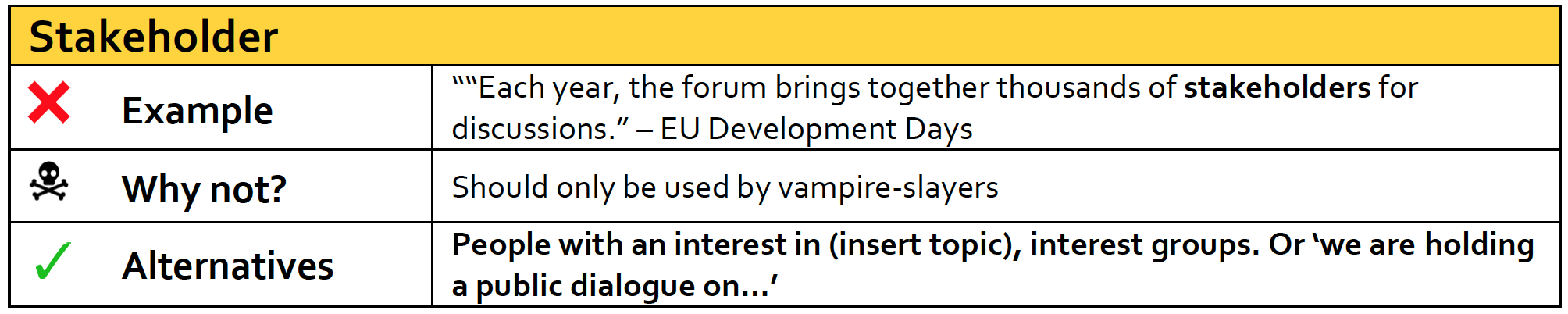
- Stakeholder. Example: “Thousands of stakeholders…” Why not: Overused and vague. Alternatives: People with an interest in…, groups.
- Sustainable. Example: “More sustainable farming practices…” Why not: Overused to the point of meaninglessness. Alternatives: Environmentally friendly, uses less water, emits less CO₂.
- Toolkit. Example: “The toolkit will contribute to…” Why not: Overused. Alternatives: Set of actions, plan, measures.
- Transparency. Example: “Greater supervisory transparency…” Why not: Unnecessarily complicated. Alternatives: Openness, clarity.
- Valorise. Example: “How could the results be valorised…?” Why not: Ugly. Alternatives: Increase the value of, enhance.
- Win-win. Example: “A win-win game for both sides.” Why not: Cliché. Alternatives: Mutually beneficial.
Related Posts
The myth of the shrinking EU Press corps
Remember all those scary stories about dwindling press numbers in Brussels a few years ago? Well, turns out they were wrong.
10 things you need to know about the EU Press Corps
I have picked out 10 essential facts you need to know about the journalists who report on the EU.

Explaining the EU: united in complexity
With over 20 years experience describing how the European Union works, what it does and what challenges it faces in speeches, articles, lectures and trainings, I thought I could explain what the EU is all about in terms that anybody could understand. How wrong I was.
Join us
Stay up to date with our latest news