
ALLISSA FISHER

JUNE 11, 2015

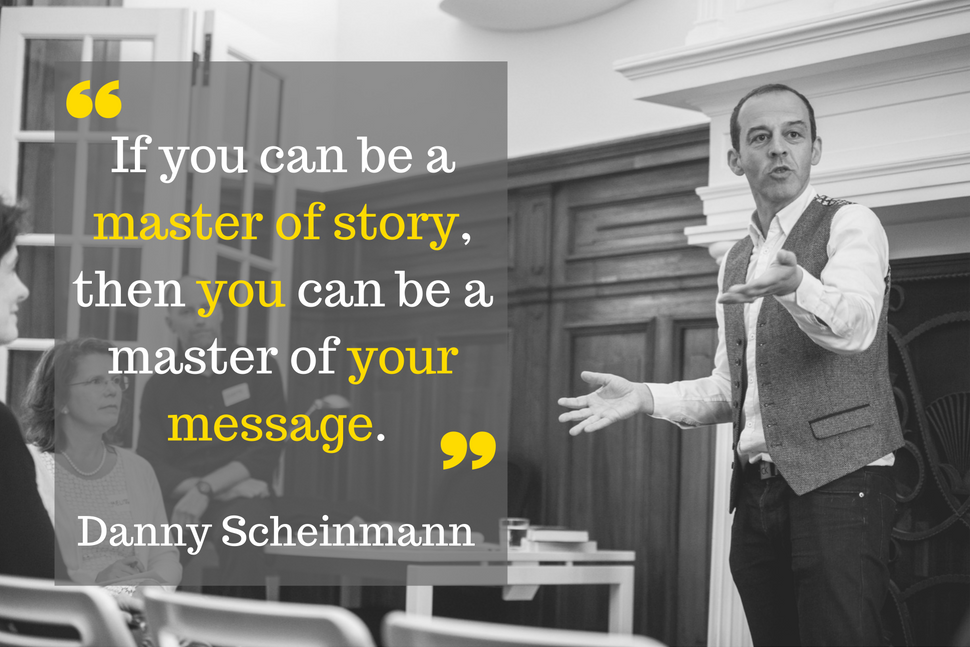
THE ART OF STORYTELLING WITH DANNY SCHEINMANN


According to Danny Scheinmann, we are all storytelling animals. There is something in all of us that just wants to know what happens next.

Danny, an actor, award-winning filmmaker and best-selling author, talked to the nearly 30 participants at our masterclass about how storytelling isn’t just used to teach lessons to children and to inform friends and family about our travels. Storytelling also has an important role in the work environment, as stories are often the best way to pass on a company or organisation’s values to customers, clients and employees.

Telling personal stories allows others to relate to us on an emotional level. Once we are in a business setting, however, suddenly we feel we have to be boring to be taken seriously. In business, we are often trying to communicate success and change in the form of hard data. The problem with this, Danny warned, is it is hard for people to remember data and messages sometimes get buried in a mound of facts and statistics.

To make our stories more vivid, Danny gave the following tips:

  • Know the reason for telling the story
  • Paint a picture with words, using detail and avoiding generalisations
  • Show what is at stake
  • Include emotions and feelings
  • Use colourful, not corporate, language

Businesses – and organisations like the EU – have a tendency to favour vague language and descriptions such as “great customer service” or “fairness to all.” Danny presented the participants with a ladder of abstraction, where the higher the rung on the ladder the more abstract the idea. The best communication happens close to the bottom of the ladder, where things are the most concrete.

Danny also equipped participants with several story archetypes that work well in business settings. These included stories that emphasise the size of a challenge (the challenge plot) or the difference before and after a new innovation or way of doing something (the creativity plot). Stories can be used to caution people on how things shouldn’t be done or to link two seemingly different viewpoints. Finally, they can be about people who inspired you or taught important life lessons.

We offer coaching on “Storytelling” with Danny Schienmann; get in touch for a tailored quote.

About the author

  • Former Senior Intern 

    She holds a master’s degree in Behavioral Economics from City St George’s, University of London and now works as a senior business analyst. 

Join us

Stay up to date with our latest news

MailChimp Subscription

Consent(Required)